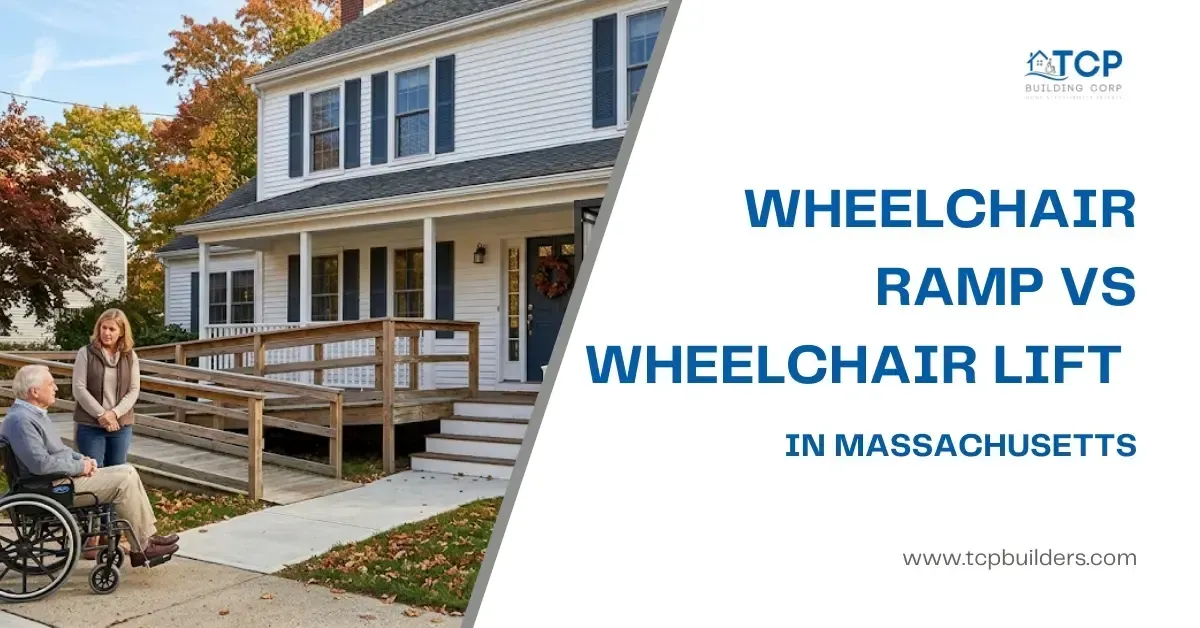
Wheelchair Ramp vs Wheelchair Lift: Which Is Right for Your Massachusetts Home?
Getting a loved one safely in and out of your home shouldn't feel like a puzzle. If someone in your household uses a wheelchair, you've likely started wondering about the best way to handle your front steps. The two most common solutions are a wheelchair ramp and a wheelchair lift, and understanding the difference between them could save you thousands of dollars and months of frustration.
The real wheelchair ramp cost depends on your home's specific layout, rise height, and material. The same is true for lifts. This guide breaks down both options for Massachusetts homeowners, so you can make a confident, informed decision without having to call five different contractors first.
We'll cover real costs, Massachusetts-specific regulations, weather performance, and the scenarios where each option makes the most sense. Let's get into it.
Understanding Your Options: Ramps and Lifts Explained
Before comparing them head-to-head, it helps to know exactly what you're choosing between. Both ramps and lifts are effective accessibility solutions, but they work in completely different ways and fit different homes.
Types of Wheelchair Ramps
A wheelchair ramp creates a sloped pathway from a lower surface to a higher one. There's no motor, no power supply, and nothing mechanical to break down. The three most common types for residential use are:
• Modular aluminum ramps: Modular aluminum ramps are the most popular choice for Massachusetts homes. They're built in sections, so you can customize the length, add landings, and configure turns to fit your specific layout. They're durable, rust-resistant, and hold up well through New England winters.
• Portable folding ramps: Portable folding ramps work well for temporary needs, like recovery after surgery. They're lightweight, easy to store, and don't require any installation.
• Threshold ramps: Threshold ramps handle small door transitions, typically one to three inches. If accessible bathrooms are essential in your home, then this is the most common place you'll need one.
If you're ready to explore options and get accurate sizing for your home, our team can help you choose the right wheelchair ramp based on your porch height, yard space, and budget.
Types of Wheelchair Lifts
A wheelchair lift moves the wheelchair user vertically using a motor-driven platform. It takes up far less horizontal space than a ramp, which makes it a strong option when the yard doesn't have room for a long run.
• Vertical Platform Lifts (VPLs) travel straight up and down. They're the most common type installed on Massachusetts residential porches and are ideal for rises of 5 feet or less.
• Inclined platform lifts travel along the angle of a staircase. They're useful when a straight vertical path isn't possible.
• Porch lifts are outdoor-rated VPLs built specifically for residential entrances. They're weatherproof and designed for frequent daily use.
Both options are solid. The right one depends on your height, available space, budget, and how you plan to use it every day.
Wheelchair Ramp vs Wheelchair Lift: Head-to-Head Comparison
Here's a quick side-by-side so you can see the key differences at a glance. We'll go deeper on each factor in the sections below.
Wheelchair Ramp Pros and Cons
A wheelchair ramp is the simpler solution on paper, but it's not always the right one. Here's an honest look at what you're getting.
Pros of a Wheelchair Ramp
• No power required: A ramp works in any weather and during any power outage. That matters a lot during Massachusetts nor'easters, when your lift could stop working entirely.
• Lower upfront cost: A modular aluminum ramp typically starts around $1,500 and can run up to $8,000 installed, depending on length. That's significantly less than most lift installations.
• No permit required: There is no permit required for most residential ramp installations in Massachusetts. You can move forward without waiting on inspections or licensing paperwork.
• Rental options exist: If you need a temporary setup after surgery or an injury, modular ramps can be rented short-term, which is rarely possible with a lift.
• Minimal maintenance: Inspect the hardware once a year and clear the surface in winter. That's about it.
Cons of a Wheelchair Ramp
• Space is the biggest obstacle: The ADA 1:12 slope ratio is the standard for accessible ramps, meaning you need 1 foot of ramp for every 1 inch of rise. A porch that sits 24 inches off the ground needs at least a 24-foot ramp. Many Massachusetts properties, especially in urban neighborhoods, simply don't have that room.
• Winter surface risk: Snow and ice build up on ramp surfaces. Without anti-slip grating or a covered structure, a ramp can become hazardous between November and March in Massachusetts.
• Visual footprint: A long ramp changes the look of your home's entrance. Some HOAs and condo associations in Massachusetts have restrictions on exterior modifications, so check your governing documents before installing.
• Physical effort: Navigating a slope still takes more energy than a flat surface, especially for manual wheelchair users or those with limited upper body strength.
MA Space Reality Check: If your porch sits 30 inches above grade, a code-compliant ramp needs to be at least 30 feet long. Many Massachusetts lots, especially in Worcester, Springfield, and Greater Boston, don't have that kind of linear yard space. A lift may be the only practical option.
Wheelchair Lift Pros and Cons
A vertical platform lift solves the space problem, but it introduces a different set of considerations. Here's what to know before committing.
Pros of a Wheelchair Lift
• Compact footprint: Most residential lifts need only about 5 feet by 5 feet of ground space. If your yard is small or your porch is surrounded by landscaping, a lift fits where a ramp never could.
• Easy to operate independently: Push a button, ride to the top. There's no incline to navigate and no physical exertion required. This matters a lot for users with limited arm strength or for elderly individuals living alone.
• Handles large rises well: When you have 5 or more steps, a lift is usually the cleaner solution. A ramp for that rise would be impractically long on most Massachusetts properties.
• Bariatric models available: If weight capacity is a concern, lifts come in models rated up to 750 pounds, which covers most bariatric needs.
• Weatherproof models exist: Outdoor-rated porch lifts are built for New England weather, though they still require annual winterization service to perform reliably.
Cons of a Wheelchair Lift
• Higher cost: The cost of an installed wheelchair lift in Massachusetts typically ranges from $8,000 to $20,000+, depending on the model, rise height, and installation complexity.
• Permit required in Massachusetts: Under 521 CMR 28.12 and the Massachusetts Board of Elevator Regulations, all residential wheelchair lifts must be installed by a licensed contractor with a permit pulled from your local municipality. This is a step many homeowners miss, and skipping it creates liability and resale complications.
• Power dependency: Electric lifts stop working when the power goes out. During a nor'easter, that's a real safety concern. A battery backup system is strongly recommended for any Massachusetts installation.
• Ongoing maintenance costs: Plan for an annual service contract ranging from $150 to $400 per year. Lifts have mechanical components that need regular inspection.
• HOA restrictions apply: Some Massachusetts condo and homeowner associations restrict exterior mechanical installations. Always review your HOA documents and get written approval before ordering.
Massachusetts Regulation Alert: Under 521 CMR 28.12, residential wheelchair lifts are regulated by the Massachusetts Board of Elevator Regulations. Installation must be performed by a licensed contractor, and a permit must be obtained before work begins. DIY installation is non-compliant and may void your homeowner's insurance.
Which Should You Choose? A Scenario Guide for Massachusetts Homeowners
There's no single right answer here. The best choice depends on your specific porch height, yard size, budget, and how you'll use the access point every day. Here are four common scenarios we see across Massachusetts homes.
Scenario 1: Small Porch (2 to 3 Steps, Adequate Yard Space)
If your porch has 2 or 3 steps and your yard has room to work with, a modular aluminum ramp is almost always the better choice. It costs less, requires no permit, and keeps working even when the power is out.
• Best choice: Modular aluminum ramp
• Why it works: No permit, lower cost, zero power dependency
• MA tip: Have anti-slip grating installed on the surface before your first winter
Scenario 2: Taller Entry (5 or More Steps or 36-Inch Rise)
When the rise gets large, a ramp becomes impractical. A 36-inch rise would require a 36-foot ramp, which is longer than most Massachusetts front yards. A vertical platform lift solves this cleanly.
• Best choice: Vertical Platform Lift (VPL)
• Why it works: Compact footprint handles large rises with push-button ease
• MA tip: Budget for the permit, licensed installer fee, and a battery backup system for nor'easters
Scenario 3: Temporary Need (Post-Surgery or Short-Term Recovery)
Not every accessibility need is permanent. After a surgery or an injury, you may only need a solution for a few months. In that case, a portable folding ramp or a rented modular ramp is the right call. Lift rental is rarely available, making this an easy decision.
• Best choice: Portable folding ramp or rental modular ramp
• Why it works: No permanent installation, no permit, and you return it when you're done
• MA tip: Many Massachusetts suppliers offer 30 to 90-day modular ramp rentals
Scenario 4: Massachusetts Condo or HOA-Restricted Property
If you live in a condo or a neighborhood with an HOA, your options may be limited before you even get to cost or size. Both ramps and lifts are exterior modifications, and both may require written HOA approval. Lifts tend to face more resistance because of their mechanical and visual profile.
• Check your HOA bylaws and condo documents before purchasing anything
• Lifts are more frequently restricted due to visual impact on shared exteriors
• Under Massachusetts Fair Housing law, a reasonable modification request for accessibility purposes is hard for an HOA to deny, but get legal advice if you face resistance
Wheelchair Ramp Cost vs Lift Cost in Massachusetts
Cost is usually what drives the final decision. Here's what you can realistically expect to pay for each option in Massachusetts, along with the funding programs most homeowners don't know about.
Wheelchair Ramp Cost in Massachusetts
Understanding wheelchair ramp cost upfront helps you plan without surprises. Prices vary based on rise height, material, and whether the ramp includes a landing or handrails.
• Portable/folding ramp: $150 to $800
• Modular aluminum ramp (installed): $1,500 to $8,000
• Custom wood ramp (installed): $3,000 to $15,000
• No permit required for most residential ramps in Massachusetts
• Annual maintenance cost: minimal, typically less than $100
Wheelchair Lift Cost in Massachusetts
• Vertical Platform Lift (installed): $8,000 to $20,000+
• Inclined platform lift (installed): $7,000 to $15,000
• Massachusetts permit fees: $25 to $350+, depending on your municipality
• Licensed installer fee: typically $500 to $2,000 on top of the equipment cost
• Annual service contract: $150 to $400 per year
Free Estimate Available: Not sure what your project will cost? TCP Building Corp offers free home assessments for wheelchair ramp and lift installations across Massachusetts. Call us at (508)-941-8576 to schedule yours.
Weather Considerations for Massachusetts Homeowners
New England winters are not gentle. Any accessibility solution installed in Massachusetts needs to hold up through snowstorms, ice, and repeated freeze-thaw cycles. This is a factor that national guides rarely address.
Ramps in Massachusetts Winters
• Bare aluminum ramp surfaces become slick when wet or icy. Anti-slip grating or abrasive tape is essential for any outdoor ramp in Massachusetts.
• Snow accumulates on ramp surfaces and needs to be cleared before use. A covered ramp structure reduces this significantly.
• Freeze-thaw cycles can shift ground anchors over multiple seasons. Inspect your ramp footings each spring and tighten any hardware that has loosened.
• Heated ramp systems exist, but add cost. They're worth considering for households where the ramp is the primary daily access point.
Lifts in Massachusetts Winters
• Most outdoor-rated VPLs are designed for cold-weather operation, but they need annual winterization service to function reliably through the season.
• Power outages during Massachusetts nor'easters can disable a lift completely. A battery backup system is not optional here; it's a safety feature.
• Check the IP weather rating and temperature operating range of any lift before purchasing. Not all models are rated for New England conditions.
• Frozen components can prevent the lift from operating even when power is available. Lubrication and seasonal prep by a certified technician are important.
Frequently Asked Questions
Is a wheelchair ramp better than a lift?
It depends on your specific situation. A ramp is usually better for 1 to 4 steps when you have yard space, because it costs less, requires no permit in Massachusetts, and works without electricity. A lift is the better choice for larger rises or tight urban lots where a long ramp won't fit. Your rise height and available space are the deciding factors.
Will Medicare pay for a ramp for seniors?
Original Medicare generally does not cover ramp or lift installations because they're considered home modifications rather than durable medical equipment. In Massachusetts, MassHealth (Medicaid) may cover modifications for qualifying members. The Massachusetts Home Modification Loan Program (HMLP) also offers 0% deferred loans for income-eligible homeowners. Call (508)-941-8576 and we'll walk you through what's available.
How long does a wheelchair ramp have to be for 3 steps?
Three average steps equal roughly 21 inches of rise. Under the ADA 1:12 slope standard, a compliant ramp needs 1 foot of length for every inch of rise. So a 21-inch rise requires at least a 21-foot ramp for independent wheelchair use. A shorter ramp is possible for attendant-assisted use, but 1:12 is the standard for safe self-propulsion.
What are the disadvantages of a wheelchair ramp?
The biggest drawback is space. A ramp for a taller porch can easily run 20 to 36 feet long, which many Massachusetts lots can't accommodate. Ramp surfaces also require winter maintenance to stay safe in ice and snow. Some HOA communities restrict their installation, and the slope itself takes physical effort to navigate for manual wheelchair users.
Do I need a permit for a wheelchair lift in Massachusetts?
Yes. Under 521 CMR 28.12 and the Massachusetts Board of Elevator Regulations, all residential wheelchair lifts must be installed by a licensed contractor and require a permit from your local building department. The permit must be obtained before installation begins. Skipping this step can void your homeowner's insurance and create issues when selling your home.
Get Expert Help Choosing the Right Solution for Your Massachusetts Home
Every home is different. Your porch height, yard layout, household needs, and budget all shape the right answer. The comparison above gives you a strong starting point, but the clearest picture comes from someone who can look at your specific setup and tell you exactly what will work.
TCP Building Corp has served Massachusetts homeowners with accessibility modifications since 2005. Our team is licensed, insured, and familiar with the local permit process across cities and towns throughout the state.
Whether you're ready to move forward or still weighing your options, a free home assessment costs you nothing and answers the questions that a guide like this one can't.
Schedule Your Free Home Assessment
We serve homeowners across Massachusetts. Licensed & Insured. No pressure, no obligation.
(508)-941-8576
